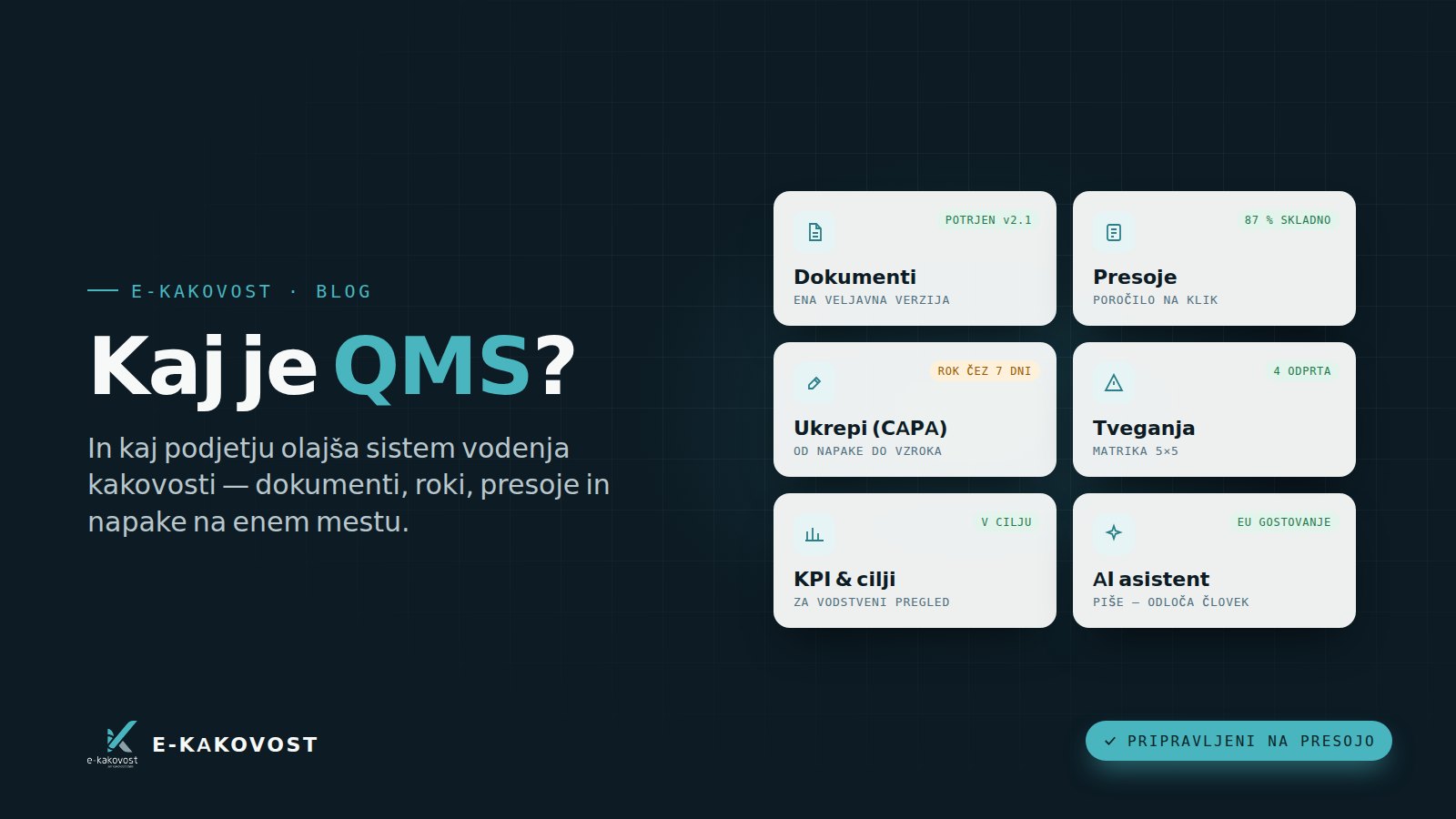
Which version of the instruction is valid? When does our calibration expire? Who is responsible for the complaint that has been waiting three weeks in the inbox of a colleague on holiday? If these questions sound familiar, you already know what a quality management system solves. Not a certificate on the wall, but everyday work.
In this article we explain what a QMS is, what exactly it makes easier for a company and how a digital QMS differs from folders, Excel and e-mail.
What is a QMS (quality management system)?
QMS stands for Quality Management System. It is an organised way for a company to plan, carry out, check and improve its work so that products and services are consistently what the customer expects.
A QMS is not a program, a folder or a person. It is a set of agreements:
- who is responsible for what (organisational structure, authorisations),
- how we work (processes, instructions, forms),
- how we know we are doing it right (indicators, audits, reviews),
- what we do when something goes wrong (non-conformities, complaints, corrective actions),
- how we learn from it (risks, management review, improvements).
The most widespread framework for a QMS is the ISO 9001 standard. The same logic applies to ISO 14001 (environment) and ISO 45001 (occupational health and safety), which is why companies often run all three in a single, integrated system. If you want to know what the standards require, read our guide to ISO standards.
What a QMS makes easier for a company: seven things from practice
From seventeen years of implementing systems in Slovenian companies we know that the benefit of a QMS is not visible in the quality manual but in everyday situations. Here are the seven we hear most often.
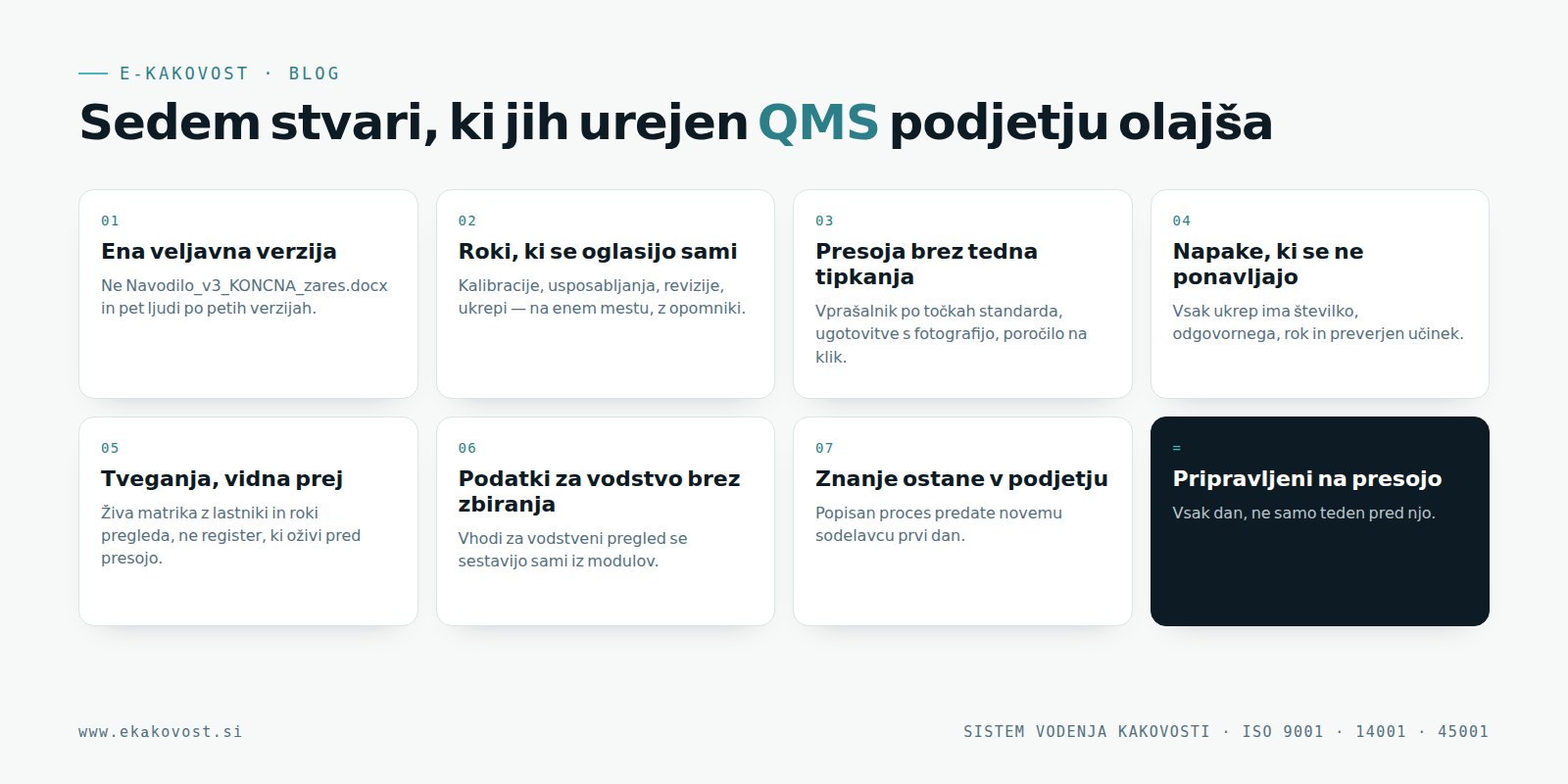
1. One valid version of a document
Without a system there is Instruction_v3_FINAL_really.docx and five people working from different versions. A QMS defines which version is valid, who approved it and who has been made aware of it. When a document changes, colleagues find out — not just at the audit.
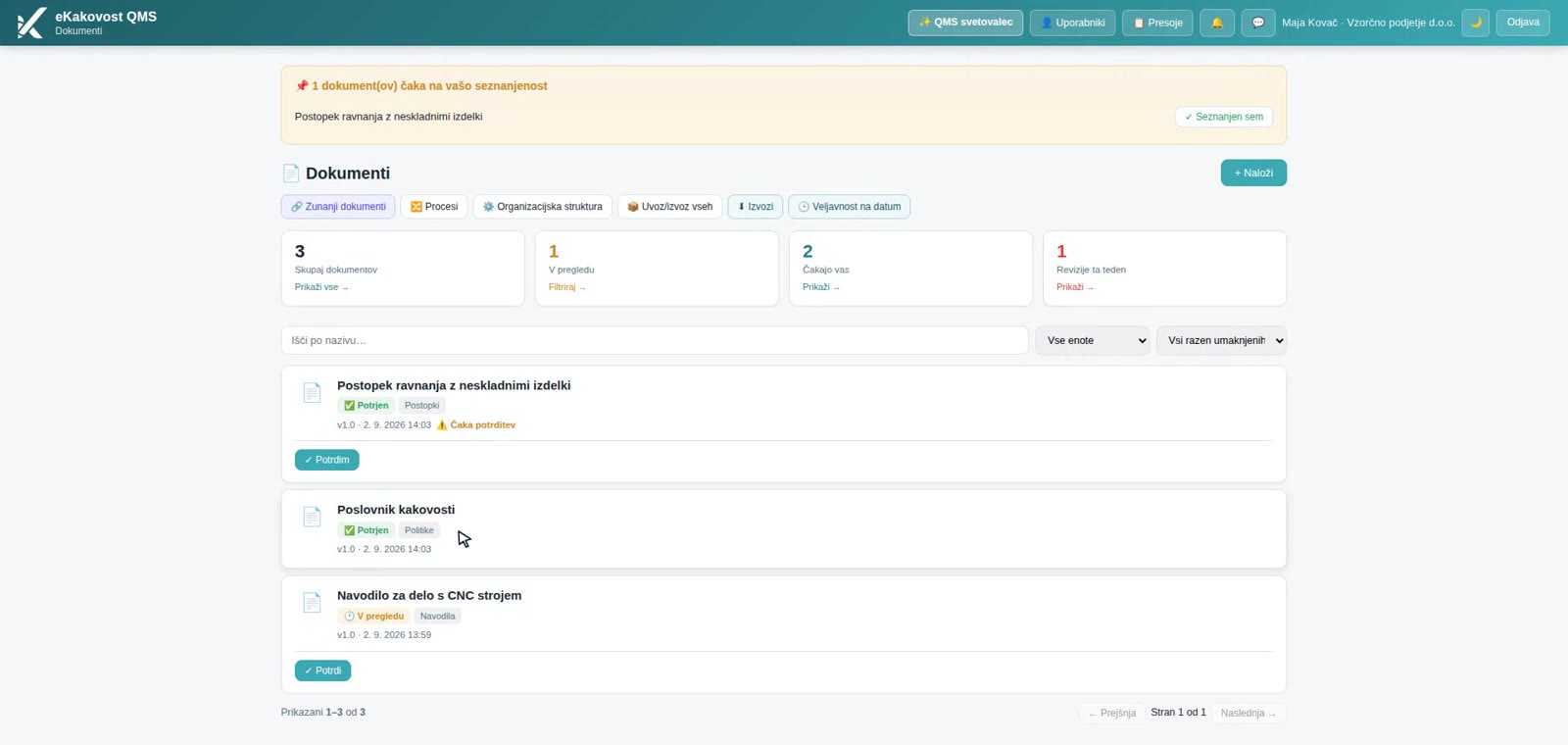 The Documents module: every document has a status, a version and an owner; whatever is waiting for your signature is at the top.
2. Deadlines that speak up by themselves
Calibration of measuring equipment, validity of training, document reviews, action deadlines, risk reviews. Each of these deadlines lives in its own calendar or in one person’s head. An organised QMS gathers them in one place and reminds the responsible person before it is too late.
3. An audit without a week of typing
An internal audit means a few hours in the department and days of writing the report. With a system that has a questionnaire by clause of the standard, findings with a photo and a report in one click, the report is done when you leave the last department.
4. Mistakes that do not repeat
A complaint, a non-conforming product or an audit finding must get a number, an owner, a deadline and a verified effect. That is the essence of corrective actions (CAPA). A spreadsheet of actions that nobody opens does not guarantee this; a system with reminders and a trail does.
5. Risks you see before they become a problem
A risk register that only comes alive before the audit is not a register. A live risk matrix with owners and review dates shows management where the exposures are today, not last year.
6. Data for management without gathering
The management review under ISO 9001 requires inputs: the status of audits, actions, complaints, risks, indicators, suppliers. If you gather this data department by department, the review is a project. If it lives in one system, the inputs compile themselves and management decides on the basis of numbers.
7. Knowledge stays in the company
Where processes are not documented, knowledge leaves with the colleague. A documented process with inputs, outputs and responsibilities is something you can hand to a new colleague on day one and improve month after month. More on this in the article Business process optimisation.
Paper, Excel or a digital QMS?
Any quality management system can be run on paper and in Excel. The question is the price. Not the licence price, but the price of searching, double entry, missed deadlines and stress before the audit.
| Folders and Excel | Digital QMS | |
|---|---|---|
| Valid version of a document | Depends on discipline | One, with approval and a trail |
| Deadlines | In several calendars | In one place, with reminders |
| Audit report | Manual, days | Automatic, minutes |
| Trail of changes | None or manual | Every change recorded |
| Preparing for the audit | Weeks | The evidence is already in the system |
| Management review | Gathering data | Inputs compile themselves |
A digital QMS does not change what the standard requires. It changes how much time you spend proving it.
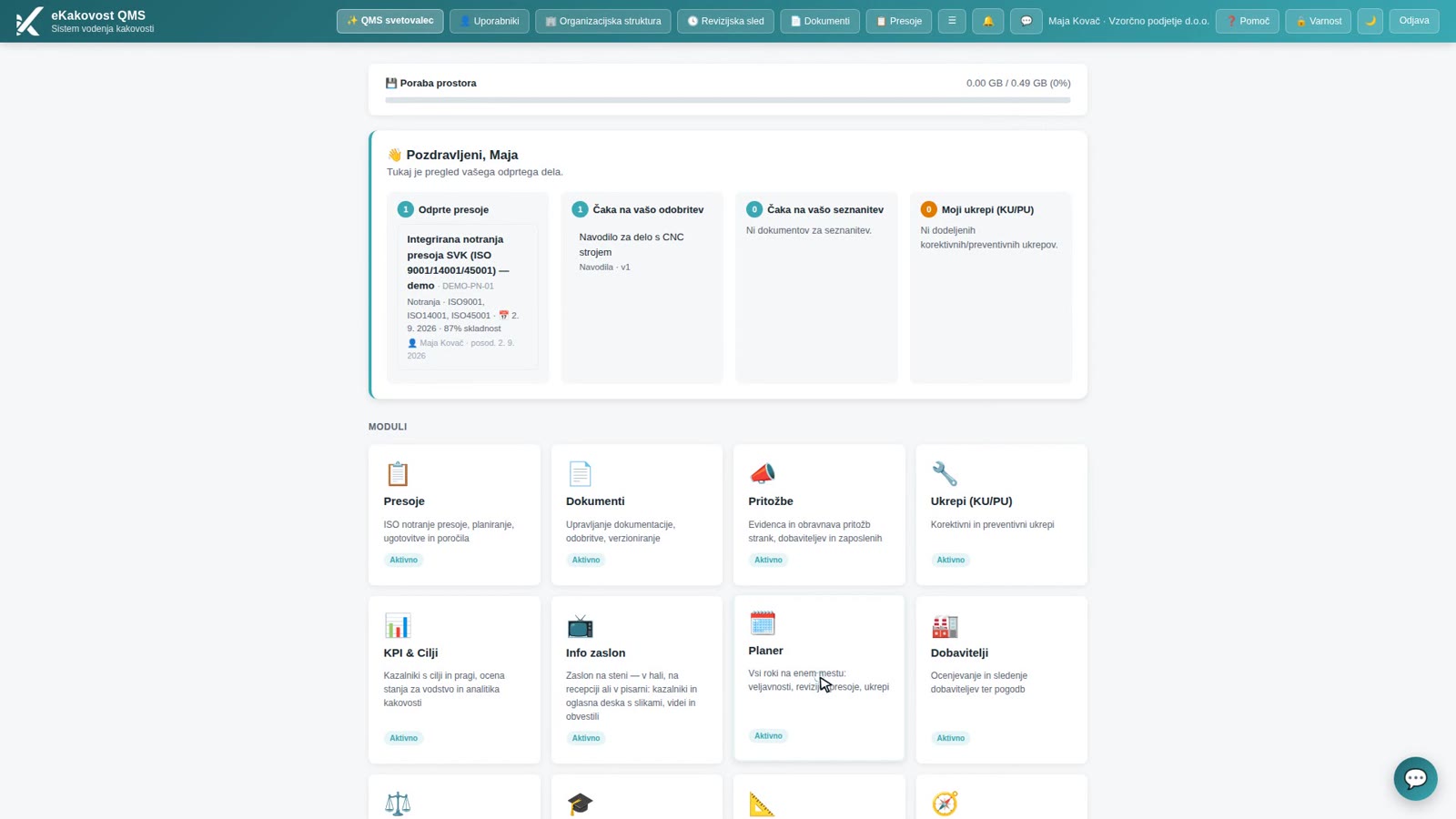 The platform’s home screen: what is waiting for you is at the top; the modules are tiles between which data flows.
The advantages of the E-KAKOVOST QMS platform
We built the E-KAKOVOST platform on our consulting experience. Every module solves a situation we saw at clients often enough for it to require a system rather than goodwill.
- Eighteen modules, one system. Documents, audits, actions, complaints, risks, KPIs, training, measuring equipment, suppliers, non-conforming outputs, management review, legislation, environment, business processes, planner, info screen, standard implementation and standard transition. Data from one module is available to another: from a complaint you open an action, from an audit a finding, from a risk an objective.
- It stands on your organisational structure. Approvals follow the org chart, acknowledgement is tracked per person, access is organised by role. There is nothing to adapt to the program; the program adapts to you.
- An AI assistant that helps write. A person decides. You write in plain language, the assistant proposes wording in the language of the standard, the proposal sits next to your original and goes into the document only once you confirm it. It invents nothing; if the input is insufficient, it says so. During an audit you dictate findings and the system files them under the clause of the standard.
- Deadlines speak up by themselves. The Planner gathers all the organisation’s deadlines on one page: documents, audits, actions, risks, training, calibrations. Overdue items are at the top and a click leads into the module.
- Every step leaves a trail. The document’s audit trail, the disposition of a non-conforming output with a name and date, a management-review decision with a deadline. You do not search folders for the auditor; you show the screen or a PDF printout.
- Legislation monitored by the system. Your register of regulations is compared automatically with the official national register. When an amendment is published that affects a regulation on your list, the system notifies you, and the impact assessment, action and evidence stay attached to the change.
- Implementation without a project. If you do not have the standard yet, the Standard implementation module guides you step by step with the requirements explained in plain language and shows your certification readiness in percent. When a new edition of the standard is published, the Transition module maps the old system onto the new one.
- Hosted in the EU, export always available. Data is kept in data centres inside the EU, encrypted in transit and at rest. Your data stays yours and you can export it at any time.
- Built in practice, in Slovenia. The platform is available in Slovene and English, with questionnaires by clause of ISO 9001, 14001 and 45001 and with support from people who implement management systems rather than just program them.
You do not have to take our word for it. Every module has a short video recorded in the application (narrated in Slovenian). See the platform module by module.
How to get started
- Take stock of what you already have. Documents, records, deadlines, owners. You will be surprised how much of a system already exists — it is just scattered.
- Pick one pain point. Documents nobody can find, deadlines that slip or complaints without a trail. Start where the effect will be visible in the first month.
- Move it into the system and invite your colleagues. A digital QMS works when everyone uses it, not just the quality manager.
- Measure. The number of open actions, missed deadlines, time spent preparing for the audit. Compare after six months.
Book a free presentation of the platform. In 30 minutes we show you the E-KAKOVOST platform on an example from your industry: how your documents, deadlines and actions would be organised. No obligation. Choose a time →
If you do not have the standard yet, at the same meeting we look at your existing system and tell you what would have the greatest effect. Slovenian companies can also obtain a subsidy of up to 60 % for implementing ISO standards.
In the coming weeks we will present one module of the platform every Tuesday: what it solves, how it works and why to use it. We start with audits.
Frequently asked questions
What does the abbreviation QMS stand for?
QMS stands for Quality Management System. It is an organised way for a company to plan, carry out, check and improve its work so that products and services are consistently what the customer expects. The most widespread framework for a QMS is the ISO 9001 standard.
Do we need a QMS if we don't have an ISO 9001 certificate?
Yes. You already have a quality management system in some form: instructions, records, complaint handling. The only question is whether it is organised or scattered across folders and colleagues' heads. An organised QMS is useful even without a certificate; the certificate is merely confirmation that the system works.
What is a digital QMS?
A digital QMS is software that manages documents, audits, actions, risks, training and indicators in one place instead of in Word, Excel and e-mail. Every change leaves a trail, deadlines speak up by themselves and the auditor gets the evidence in one click.
How long does it take to implement a digital QMS?
If you already have a management system, it is a migration: upload the documents, define the organisational structure and responsibilities, invite your colleagues. The first modules are working within days. If you are only setting up a system, the Standard implementation module guides you step by step and shows your certification readiness in percent.
Where is the E-KAKOVOST platform's data stored?
Data is hosted in data centres inside the EU, encrypted in transit and at rest, and always available for export. Access is organised by role and by the company's organisational structure.
Transparency: artificial-intelligence tools were used in preparing this article. The content was reviewed and approved by the author.