What a quality management system is
A quality management system (QMS) is not a folder, a program or a certificate. It is a set of agreements on who is responsible for what, how we work, how we know we are doing it right, what we do when something goes wrong and how we learn from it. Every company has a system in some form; the question is whether it is organised and demonstrable or scattered across folders and people’s heads.
The most widely used framework for a quality management system is ISO 9001:2015. ISO 14001 (environmental management) and ISO 45001 (occupational health and safety) share the same structure, so companies often run them as one integrated system. A longer explanation with practical examples is in What is a QMS and what does a quality management system make easier.
The principles of ISO 9001
ISO 9001 is based on the seven quality management principles of ISO 9000: customer focus, leadership, engagement of people, process approach, improvement, evidence-based decision making and relationship management. In practice the standard rests on three concepts:
Process approach
You understand work as linked processes with inputs, outputs, owners, resources and KPIs, not as separate departments. Clause 4.4 requires you to determine processes, their interactions and how they are controlled. How to map and improve processes is covered in Business process optimisation as the foundation of company quality.
The PDCA cycle
Plan, do, check, act. The structure of the standard follows this cycle:
| Step | ISO 9001 clauses | Content |
|---|---|---|
| Plan | 4–7 | context, leadership, risks and objectives, resources, competence, documented information |
| Do | 8 | operation: customer requirements, design, external providers, production and service provision, nonconforming outputs |
| Check | 9 | monitoring and measurement, customer satisfaction, internal audit, management review |
| Act | 10 | nonconformity and corrective action, continual improvement |
Risk-based thinking
Clause 6.1 requires you to determine risks and opportunities from the context of the organisation and the expectations of interested parties, and to plan actions proportionate to their potential impact. The standard does not prescribe a method; a likelihood and consequence matrix is common.
Building blocks of the system
- Documentation (clause 7.5): documented information that is identified, approved, available and protected, with a clear valid version.
- Internal audits (clause 9.2): a planned audit programme showing whether the system works as documented.
- Corrective actions (clause 10.2): from nonconformity through root cause analysis to verified effectiveness.
- KPIs (clause 9.1): measurable objectives and process monitoring as the basis for management decisions.
- Risks and opportunities (clause 6.1): a register with owners, ratings and actions.
- Training and competence (clause 7.2): who needs to know what, and evidence that they do.
- Management review (clause 9.3): top management reviews system results at planned intervals and decides on improvements.
How these building blocks lead to certification and what the cost is made of is described on the ISO 9001 certification page. Why the standards pay off and where subsidies come in is summarised in the guide to ISO quality standards.
What a digital quality management system means
Any system can be run on paper and in Excel. A digital system does not change what the standard requires; it changes the cost of meeting it: how much time you spend finding the valid version, retyping reports, collecting data for the management review and chasing deadlines. In a digital system:
- every document has one valid version, an approval and an acknowledgement trail,
- deadlines (revisions, calibrations, actions, risk reviews) remind the owner automatically,
- an audit finding becomes an action with a deadline, not a line in a report,
- management review inputs are assembled from data that already exists,
- you show the auditor a screen or a printout, not folders.
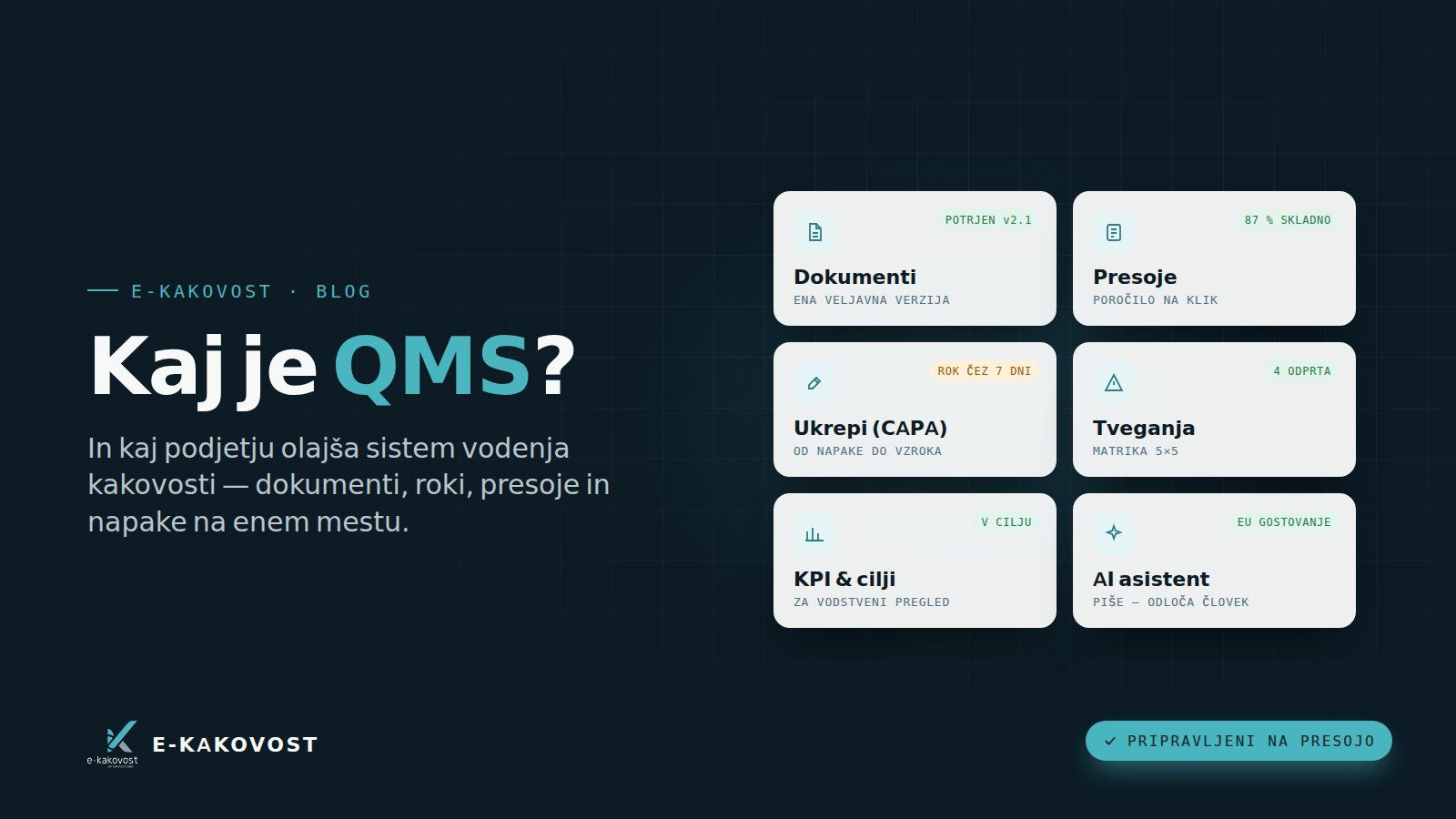
That is how the E-kakovost QMS platform works: modules for documents, audits, actions, risks, KPIs, training, equipment and other building blocks, with data flowing between them.
Platform modules, one by one
Each module has an article explaining the requirement of the standard and a short video recorded in the application:
- The Audits module: an internal audit without days of typing up the report
- The Documents module: one valid version
- The Equipment module: calibration cycle, maintenance and breakdowns in one place
- The Actions module (CA/PA): from a failure to its root cause
Where to go next
- What is a QMS and what does a quality management system make easier?Seven situations from practice and a comparison of paper, Excel and a digital QMS.
- ISO quality standards: what, why and howISO 9001, 14001 and 45001 in brief, with a note on subsidies.
- Business process optimisationThe process approach in practice.
- ISO 9001 certificationProcess, timeline, costs and common mistakes.
- ISO 14001 consultingEnvironmental aspects, legislation and the life cycle perspective.
- E-kakovost QMS platformAll modules, data security and a free consultation.
Frequently asked questions
What is a quality management system?
A quality management system (QMS) is the organised way an organisation defines its processes, responsibilities and resources so that its products and services are consistently what customers expect, and how it checks and improves this. The most widely used framework is ISO 9001.
Is a quality management system the same as ISO 9001?
Not quite. Every organisation has a quality management system in some form. ISO 9001 is the standard that sets requirements for it, and ISO 9001 certification confirms that the system meets them.
What are the quality management principles?
ISO 9000 lists seven principles: customer focus, leadership, engagement of people, process approach, improvement, evidence-based decision making and relationship management.
What does PDCA mean?
PDCA (plan, do, check, act) is the improvement cycle ISO 9001 is built on. Clauses 4 to 7 cover planning and support, clause 8 operation, clause 9 performance evaluation (audits, KPIs, management review) and clause 10 improvement.
What is a digital quality management system?
A system in which documents, audits, actions, risks, training and KPIs live in one piece of software instead of folders, Excel and email. The requirements of the standard stay the same; what changes is how much time it takes to meet and demonstrate them.