What ISO 14001 is
ISO 14001 is the international standard for an environmental management system. It does not prescribe emission limits or technologies; it requires a company to know its effect on the environment, comply with the legislation that applies to it, set environmental objectives and continually improve the system. Its structure is the same as ISO 9001 (clauses 4 to 10), so the two standards combine well into one management system.
Environmental aspects and impacts
The core of the standard is clause 6.1.2. An environmental aspect is an element of your activities, products or services that can interact with the environment; an environmental impact is the resulting change to the environment. Typical aspects are:
- use of energy, water and raw materials,
- emissions to air and waste water,
- waste generation and handling,
- use and storage of hazardous substances,
- noise, traffic and transport.
You identify aspects for normal operation, for emergencies (for example a spill or a fire) and from a life cycle perspective. You then evaluate them against predefined criteria and determine controls for the significant environmental aspects: instructions, objectives, monitoring or actions. For emergencies the standard also requires preparedness and response (clause 8.2), including periodic testing of the planned response actions where practicable.
Legislation: compliance obligations
Clause 6.1.3 requires you to know your compliance obligations: legal requirements (environmental legislation, environmental permits, rules on waste, emissions and packaging) and other requirements you have adopted, such as customer requirements. Clause 9.1.2 then requires you to evaluate regularly whether you fulfil them and to document it.
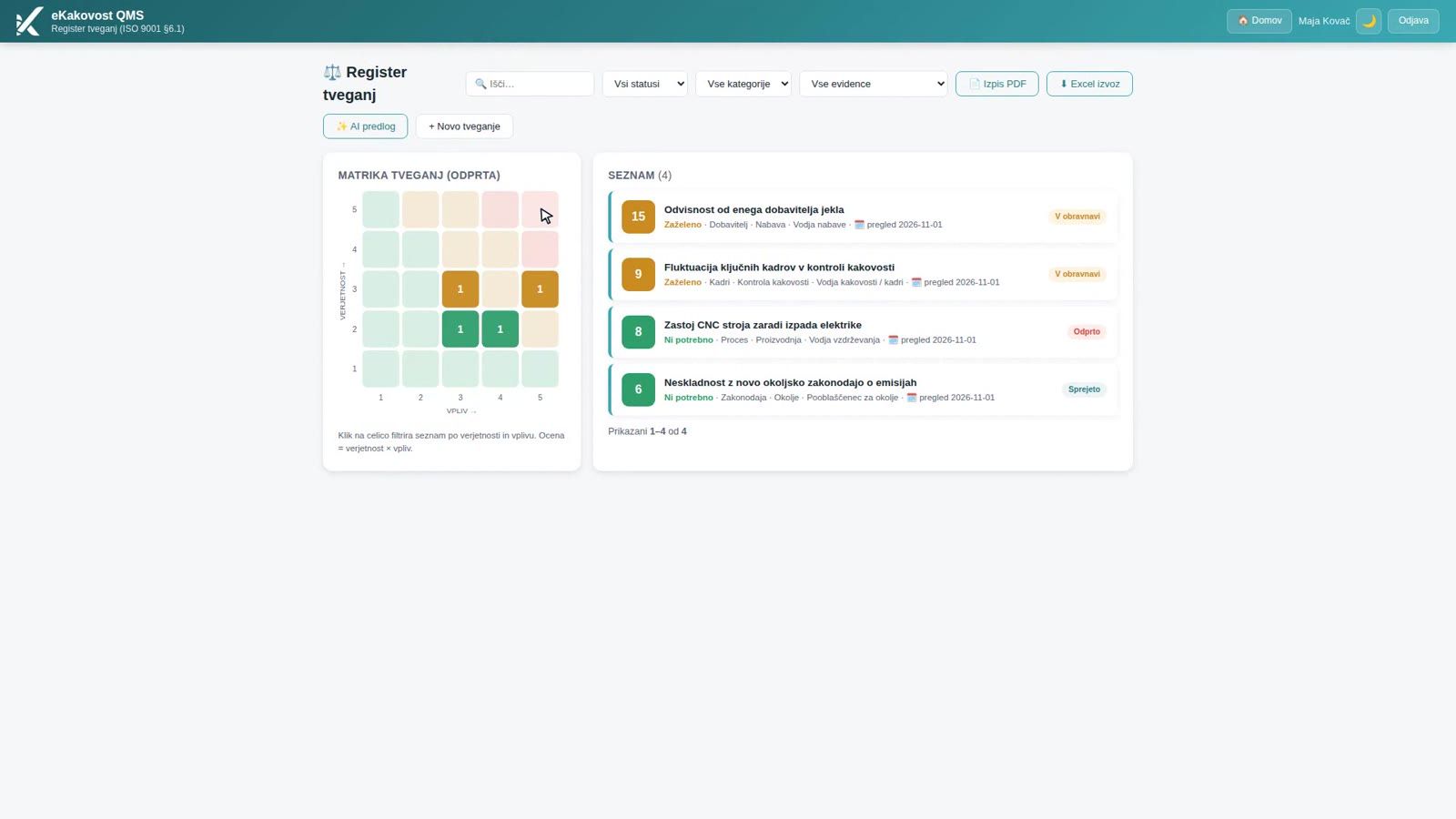
In practice the hardest part is keeping up with changes to legislation. The E-kakovost QMS platform has a Legislation module for this: the register of regulations is automatically compared with the official national register, you are notified when an amendment affects a regulation on your list, and the impact assessment, action and evidence stay attached to the change. All modules are on the QMS platform page.
The life cycle perspective
ISO 14001:2015 requires a life cycle perspective: for aspects and operational control (clause 8.1) you consider the stages you can influence, from procurement of raw materials and requirements for suppliers to the use and end of life of the product. A full life cycle assessment (LCA) is not required but can be a good basis for decisions. How to approach it is covered in Product life cycle assessment (LCA).
Implementation steps
- Context and scope: environmental conditions, interested parties and their expectations, boundaries of the system.
- Environmental policy: a commitment to protecting the environment, including prevention of pollution, fulfilling compliance obligations and continual improvement.
- Register of environmental aspects with evaluation and identification of significant aspects.
- Register of legislation and other requirements, and how compliance is evaluated.
- Risks, opportunities and environmental objectives with a plan of who does what by when.
- Operational control and emergency preparedness: instructions, training, requirements for suppliers.
- Monitoring and measurement: consumption, waste, emissions, evaluation of compliance.
- Internal audit and management review, followed by the stage 1 and stage 2 certification audits by an accredited certification body.
For the internal audit you can use the questionnaire by ISO 14001 clause in the Audits module, and follow findings through to verified effectiveness in the Actions module.
How our consulting works
We start with an on-site gap assessment: which environmental aspects you have, which legislation applies to your activities and what already exists. We then prepare the registers, policy and objectives with you, train the people responsible and guide you through the internal audit to certification. If you already have ISO 9001, we build ISO 14001 into the existing system so that you do not end up with two parallel systems.
The full offer, including ISO 9001 and ISO 45001, is on the ISO consulting page; how certification works and what the cost is made of is on the ISO 9001 certification page (the process is the same for ISO 14001).
Frequently asked questions
What is the difference between an environmental aspect and an environmental impact?
An environmental aspect is an element of your activities, products or services that can interact with the environment, for example energy use, emissions to air, waste generation or the use of hazardous substances. An environmental impact is the resulting change to the environment, for example air or soil pollution. ISO 14001 requires you to identify and evaluate aspects and control the significant ones.
Does ISO 14001 require a life cycle assessment (LCA)?
No. ISO 14001:2015 requires a life cycle perspective: when identifying environmental aspects and planning operational control you consider the stages you can influence, from procurement to the end of a product’s life. A full LCA under ISO 14040/14044 is not required, although it can be a useful basis.
What are compliance obligations?
Legal requirements that apply to your activities (environmental legislation, environmental permits, rules on waste, emissions and packaging) and other requirements you have chosen to adopt, such as customer or industry association requirements. The standard requires you to know them, take them into account and regularly evaluate whether you fulfil them.
How long does ISO 14001 implementation take?
Similar to ISO 9001, usually 3 to 9 months, depending on company size, activities and the amount of legislation that applies to you. If you already have ISO 9001 it is faster, because the standards share the same structure and can share documents, audits and the management review.
Can ISO 14001 be combined with ISO 9001 and ISO 45001?
Yes. All three standards share the same high-level structure (clauses 4 to 10), so companies often run them as one integrated management system: shared documents, one internal audit against several standards and one management review.
Is ISO 14001 mandatory?
No, the standard is voluntary. Customers in supply chains and tenders increasingly require it, though, and environmental legislation applies to the company regardless of certification. ISO 14001 helps you track and meet it systematically.
Are there subsidies for ISO 14001?
Slovenian companies can obtain a subsidy for implementing management systems. We check eligibility and the conditions of current calls in a free consultation.